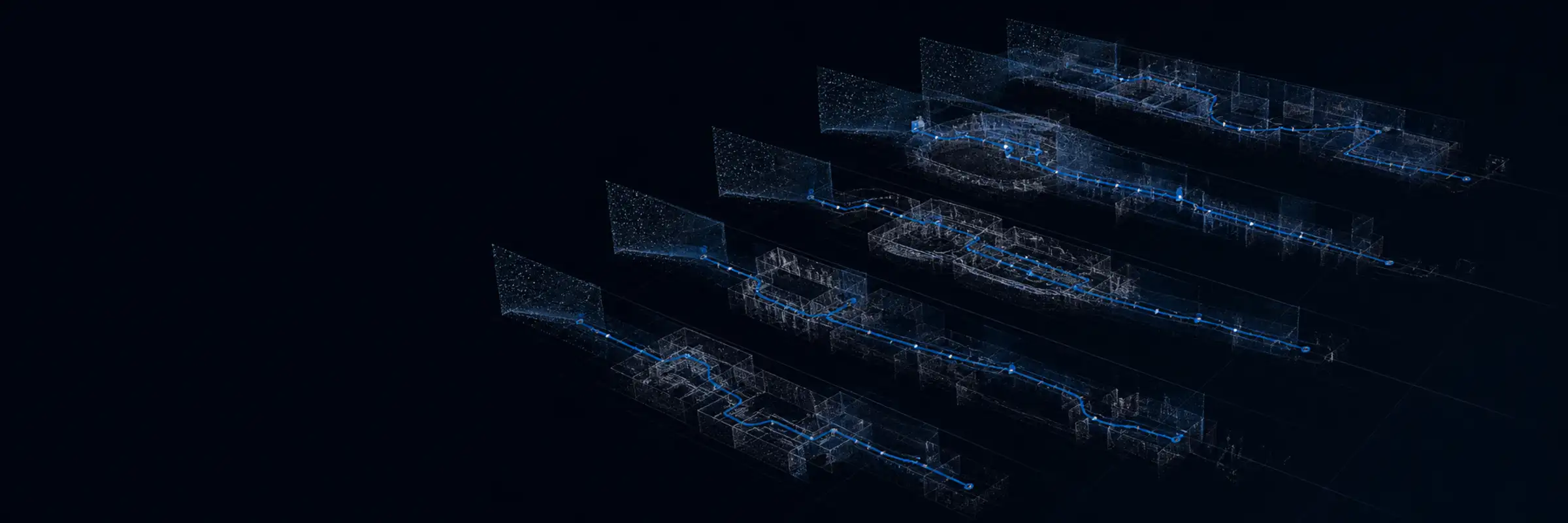
Start with the check that costs you the most visits.
Four workflows teams bring us. Yours will not match exactly, and that is fine.
Life-safety inspection
The problem
Someone has to establish that the required safety equipment is present, correctly placed and unobstructed, site by site, floor by floor, on a schedule.
How it usually works today
An inspector walks with a clipboard or a phone camera. The output is a tick list and a folder of photos that nobody can trace back to a specific location once the visit is over.
The PRISM workflow
- 1.An operator walks the floor once with guided capture, watching coverage as they go.
- 2.The scan is processed and the configured AI runs across the sampled frames.
- 3.Each extinguisher, sign or hazard becomes an object with a position in the space and the frames that evidence it.
- 4.A reviewer opens the scan in a browser, works through the findings, and sees exactly where each one sits.
- 5.When the standard or the question changes, the same scan is re-run instead of re-walked.
Roles involved
Field operator · Fire safety or compliance lead · Remote reviewer
Checks this workflow uses
Fire extinguishers · Exit signs and egress · PPE · Custom rules and pass/fail
What you end up with
A dated, located record of what safety equipment was present and where
Facility condition and defects
The problem
Defects are found by whoever happens to be in the room, described in words, and then rediscovered by the engineer sent to fix them.
How it usually works today
A photo of a leak arrives in a ticket with the caption "plant room, second floor". Someone spends the first twenty minutes of the visit finding it.
The PRISM workflow
- 1.Capture the plant rooms, risers and circulation space in one walk.
- 2.Detection runs for the defect classes you care about: leaks, corrosion, damage, missing components.
- 3.Findings are placed in the 3D scene, so the location is a coordinate rather than a description.
- 4.Maintenance opens the finding, sees the source frame and navigates to the spot in the scene before dispatching anyone.
- 5.The scan stays available as the baseline for what the space looked like on that date.
Roles involved
Facilities team · Maintenance engineer · Operations lead
Checks this workflow uses
Leaks and broken pipework · Corrosion, cracks and damage · Missing components · Condition grading · Cross-visit comparison
What you end up with
Located defects an engineer can navigate to, with the evidence attached
Multi-site brand and asset audit
The problem
Head office needs to know whether what was specified for a site is actually installed, in the right place, across a large estate.
How it usually works today
Site managers are asked to send photos. Compliance is measured by who replied, and a photo of the right poster proves nothing about which wall it is on.
The PRISM workflow
- 1.A site walk captures the customer-facing space once.
- 2.Recognition identifies the fixtures, artwork or equipment in scope.
- 3.Each is positioned in the space, so "installed" and "installed in the right place" are different answers.
- 4.Head office reviews sites from a single map and scan list rather than an inbox.
- 5.A new campaign or asset class runs against the same scans without another estate-wide visit.
Roles involved
Retail or estate operations · Brand and marketing compliance · Site manager
Checks this workflow uses
Posters, signage and branded assets · Inventory and counts · Serial numbers and asset tags · Inspection summaries
What you end up with
Per-site evidence of what is installed and where, comparable across an estate
Existing conditions and handover
The problem
Work depends on knowing what is actually there, and disputes depend on proving what was there on a given date.
How it usually works today
Existing-condition checks are ad hoc, and discrepancies surface late, when they are expensive to resolve.
The PRISM workflow
- 1.Capture conditions before, during or at handover.
- 2.The scan is preserved as dated, located spatial evidence with measurable geometry.
- 3.Reviewers measure distances and areas in the scene remotely.
- 4.If a question arises later (what was installed, what was damaged) it is asked of the scan, not of memory.
Roles involved
Field operator · VDC or BIM team · Project manager
Checks this workflow uses
Corrosion, cracks and damage · Missing components · Inventory and counts
What you end up with
A measurable, dated capture of conditions as they were found
Tell us what you need to check.
Bring the question you are trying to answer about your sites, and we will tell you straight whether PRISM answers it.